TestCoupon1 of 7

Describe a board. Get one you can argue with.

You write what you want built. TestCoupon comes back with a block diagram, a part for each block, and the resistor and capacitor values around each part, with where every value came from. Then it checks the KiCad board.

The goal is words in, files you can send to a manufacturer out. We're not there yet. This deck shows how far it gets today.

Tatsu Ikeda, October 2026. Seven slides. Most of what's on them is pasted out of real runs and the repo.

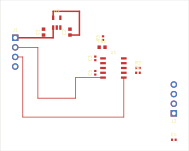
Copper plot of a small two-layer board: a 10-pin microcontroller, a regulator, two headers, and a handful of passives

My test board for the checking half. 13 parts, 50 by 40 mm, with defects planted on purpose. Slide 5 is what the tool says about it.

TestCoupon2 of 7

A real run: "a USB-C power bank," 9 September.

It asked follow-up questions (I gave eight answers), drew a block diagram with nine blocks, then picked a part for each block from DigiKey's live catalogue and checked every candidate against that block's requirements.

BlockPart it pickedPrice, stockChecks passed
batteryAdafruit 5035$29.95, 6652 of 2a finished pack, plausible for a bank
usb_c_portAmphenol 10164359-00011LF$0.48, 32,0911 of 1
pd_controllerST STUSB4531QTR$3.17, 2,8673 of 3sound pick
power_path_managementnone0 checkedthe search returned nothing
system_rail_regulatorMaxLinear SPX5205M5-L-3-3/TR$0.38, 29,5422 of 2
mcuAnalog Devices FIDO1100PQF208IR1$0.00, 965 of 5wrong. A discontinued industrial comms controller
power_buttonE-Switch TL3315NF100Q$0.15, 44,540none derivedranked only
status_ledLite-On LTST-C190GKT$0.14, 1,494,531none derivedranked only
battery_protectionSeiko MS621FE$2.20, 36,8583 of 3wrong. That's a coin cell

planning/Chip Selection/TEST_RUN_2026-09-09.md, read from the API that night. 26 minutes for the one prompt. Two wrong, one empty, six I haven't found a problem with. The two wrong ones passed every check, and that's the bug: the search looked in the wrong place and the checks couldn't tell.

TestCoupon3 of 7

Every value says where it came from.

Once a chip is picked, it opens that chip's datasheet, finds the design equation, pulls the constants off the page, and solves for the part you have to buy.

part       AZ1117C adjustable regulator, target 3.3 V
equation   VOUT = VREF * (1 + R2/R1) + IADJ * R2
R1         124 ohm      page 3
VREF       1.25 V       page 4
IADJ       60 uA        page 4
solve      R2 = 202.16 ohm
nearest    E96 200 ohm, 1 percent, 0603
buy        RMCF0603FT200R, 393k in stock

docs/dev-run-2026-09-07, items 04 and 05. The solve is plain algebra in code, same answer every run.

A language model finds the equation and reads the constants. It doesn't do the arithmetic and it doesn't get to pick which unknown to solve for. I had it solve the same equation five times with the model's answer flipped by hand, and the value came out identical each time.

When it can't open a datasheet it says "cannot verify" for that part. On the 9 September run that happened a lot: whole vendors refused the download, and the result didn't say which parts were catalogue data only. That's logged and not fixed.

TestCoupon4 of 7

The hard part is the block diagram.

Getting from a sentence to the right set of blocks is where it's weakest. It does okay on the two prompts we tuned it on, a Bluetooth speaker and the power bank. On anything else it's worse.

Brandon's fix, which I spent the last week building: don't invent the diagram. Keep a library of block diagrams that engineers already drew, find the closest one to what you asked for, and start from that.

Does the right diagram land in the top 20?
You name the product ("a Bluetooth speaker")99%
You describe it without naming it, first try66%
Same, after adding a summary to each entry87%
Plain keyword search, for comparison76% and 19%

Measured 27 September over 661 diagrams. Another 961 from design guides are being added; 258 of those still have labels it couldn't resolve. It's wired into the interview and switched off by default until the numbers are better.

TestCoupon5 of 7

Then it checks the board, and says what it skipped.

$ hwci check tests/fixtures/demo
rules run: 19 (waived findings: 0, no waiver configured)

COVERAGE
  pins compared against a datasheet pin table: 0
  NOT CHECKED: 2 (U1, U2)
  NOT CHECKED, no rule exists: layout: no rule in this pack judges placement or routing quality
  NOT CHECKED, no rule exists: signal integrity: no rule in this pack computes impedance, crosstalk, or timing
  NOT CHECKED, no rule exists: EMC: no rule in this pack evaluates emissions or susceptibility
[cut]
error    decoupling-proximity  U2  U2 pad 5 on power net '+3V3': nearest capacitor C2 is 6.38 mm away (limit 3 mm)
error    floating-pins         U2  U2 pin 3 (EN) is unconnected: no wire, label, or no-connect marker
error    i2c-pullups           U1  I2C line 'SCL2' has no pullup resistor to a power net (bus cannot idle high)
[8 more findings cut]
7 error(s), 2 warning(s), 2 info

Run 1 October on the test board from slide 1. Lines cut and columns narrowed; nothing reworded. This half also works on a KiCad board you already have.

How much does it catch? I wrote down 47 ways a design can be wrong, put each into 25 real open-source boards, and ran it. 262 of 601, 43.6%. Sixteen of the 47 it has never caught once.

That method comes from an engineer who did it for circuit boards at Bell Labs starting in 1977. This half isn't what we're working on this month. Generation is.
TestCoupon6 of 7

What doesn't work yet.

  • It doesn't draw the schematic or the layout. It stops at blocks, parts and values. The steps after that aren't started.
  • Block diagrams are passable on two prompts and worse on the rest.
  • Part selection picks the wrong thing sometimes and doesn't know it. Slide 2 has two.
  • One prompt took 26 minutes.
  • Customers. None.
  • A fabricated board. You don't have real proof until you've actually built one, and we're not there yet.
  • I'm a software person, not an EE. Brandon designs boards for a living. He's building the part selection and he's the one who can tell when the output is wrong.
  • Investors. Not raising. It runs on AWS credits.

The generating half uses a language model, with code checking what it hands back. The checking half on slide 5 has no model in it. I wrote most of the code with an AI coding assistant.

TestCoupon7 of 7

What I'm asking for: three people with something real to build.

Tell me in a sentence or two what you need. Or send a KiCad board you're about to fab. Either works.

I run it and send you everything that comes back: the questions it asked, the block diagram, the parts and why, the values and which datasheet page, and the list of what it couldn't check. Including the parts where it's wrong.

Free. Then tell me what was useful and what was garbage.

Tatsu Ikeda   hello@testcoupon.dev

If you know someone who should see this, forward it. testcoupon.dev